1
/
of
2
DeVilbiss
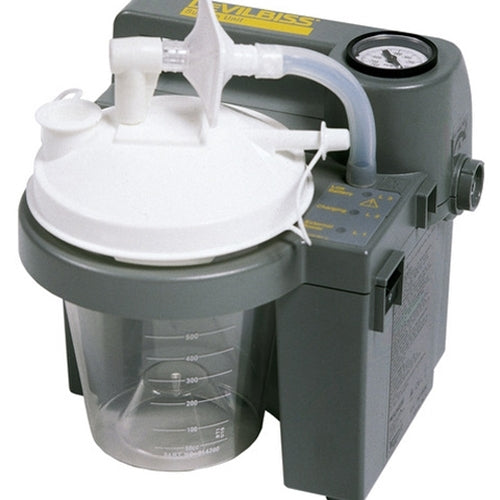
DeVilbiss 7305 Series Homecare Suction Unit
DeVilbiss 7305 Series Homecare Suction Unit
Regular price
$0.00 USD
Regular price
Sale price
$0.00 USD
Unit price
/
per
Couldn't load pickup availability
7305D-D
Suction Unit, 800cc disposable bottle, tubing, elbow, and AC and DC power cords (does not include carry case)
7305P-D
Suction Unit, 800cc disposable bottle, tubing, elbow, AC and DC power cords, carry case and rechargeable battery
7305D-D-EXF
Suction Unit, 800cc disposable container with external filter, tubing, elbow, and AC & DC power cords
7305P-D-EXF
Suction Unit, 800cc disposable container with external filter, tubing, elbow, AC & DC power cords, and rechargeable battery
Product Highlights
- Vacuum adjustment allows for 80–550 mm Hg and a free flow of 27 liters/minute
- Meets American Association for Respiratory Care (AARC) guidelines for neonatal, infant, child and adult homecare suctioning
- Switch mode power supply allows operation on any AC voltage 100 V 240 V
- Integrated bacterial filter
- Automatic float shut-off to prevent overflow into the unit
- Uses a rechargeable battery with 60 minutes run time
- Automatically recharges when connected to the power supply
- 12 V DC capability for vehicle charging
- Manufactured and tested to ISO10079-1:1999 Standard for Suction Equipment, achieving outstanding performance in the following tests:
- Electromagnetic Compatibility Test – VacuAide does not interfere with or is not susceptible to interference from other equipment such as ventilators
- Drop Test and Shock Vibration Test – VacuAide is far less likely to be damaged when dropped or shipped
- Excessive Temperature Test – VacuAide effectively works in a wide range of environmental temperatures
AARC Guidelines for appropriate sub atmospheric pressures:
- Neonates: 60 - 80 mm Hg
- Infants: 80 - 100 mm Hg
- Children: 100 - 120 mm Hg
- Adults: 100 - 150 mm Hg
Negative pressures should not exceed 150 mm Hg as higher pressures have been shown to cause trauma, hypoxemia and atelectasis.
Share